The median home sale price in Irvine, CA sits at roughly $1,540,000 as of mid-2026. That number alone shapes a lot of housing decisions for older adults thinking about downsizing and living in Irvine. With 744 active listings across the city and a median of 48 days on the market, there's inventory out there - but at that price point, specialized senior housing starts looking pretty attractive by comparison.
If you're exploring retirement communities in Irvine, CA, the options run from age-restricted apartment rentals to full-service continuing care facilities. The right fit comes down to three things: your health needs, your budget, and whether you want to rent or own your next home outright.
Overview of 55+ and Active Adult Living in Irvine
The federal Housing for Older Persons Act governs age-restricted neighborhoods across the country. Under the standard 80/20 rule, at least 80% of the occupied units in a designated 55+ community must have at least one resident who is 55 or older. That's what gives these developments the legal standing to restrict who can buy or rent there.
In Irvine, these communities are built around low-maintenance living - grouping residents with similar lifestyle preferences and taking exterior upkeep entirely off their plate.
Types of Communities in Irvine
Irvine offers a mix of property types for older adults: independent living, assisted living, and continuing care retirement communities (CCRCs). Some developments are strictly rental apartment buildings; others sell fee-simple condos or detached homes.
The local landscape also includes several large campus-style facilities operated by major senior living brands. These campuses often blend independent apartments with higher levels of care on the same grounds - which matters a lot if your needs are likely to change.
Who Qualifies Under the Age Rules
The primary resident must meet the 55+ age requirement to purchase or sign a lease in an age-restricted community. A younger spouse or partner can usually live there too, as long as the primary resident clears the age threshold.
Adult children and other younger family members generally can't live in the unit full-time. Most HOAs and property management companies set strict limits on how many days underage guests can stay in a given year - so don't assume the rules are flexible on that point.
Types of Senior Housing Available in Irvine
Orange County's low-income threshold for a single person in 2026 is $104,200, which factors into how some subsidized senior apartments are structured. For everyone above that line, market rate applies across several different levels of care and independence.
The distinctions between categories matter more than people expect, and facilities in Irvine generally fall into one of three operational models.
Independent Living and 55+ Apartments
Independent living communities work much like a standard apartment building or condo complex, but with an age restriction. There's no medical care, no daily living assistance - just housing, shared amenities, and the absence of a lawn to mow.
Residents typically get access to clubhouses, fitness centers, and organized social events. It's a solid setup for active adults who want to downsize without taking on another maintenance-heavy property.
Assisted Living and Memory Care
Assisted living facilities pair housing with personal care services - help with bathing, dressing, medication management, that sort of thing. Caregivers are on-site around the clock.
Many of these facilities also include dedicated memory care wings: secure environments with structured routines designed specifically for residents living with Alzheimer's or other forms of dementia.
Continuing Care Retirement Communities (CCRC)
A CCRC takes a tiered approach to aging in place, combining independent living, assisted living, and skilled nursing care on one campus. The idea is that you move in while you're still independent and transition to higher levels of care without ever having to relocate to a new facility.
It requires a meaningful upfront financial commitment, but it buys you long-term care access and a degree of certainty that's hard to put a price on. Irvine has specific CCRCs built around exactly this model.
Local 55+ and Retirement Communities to Consider
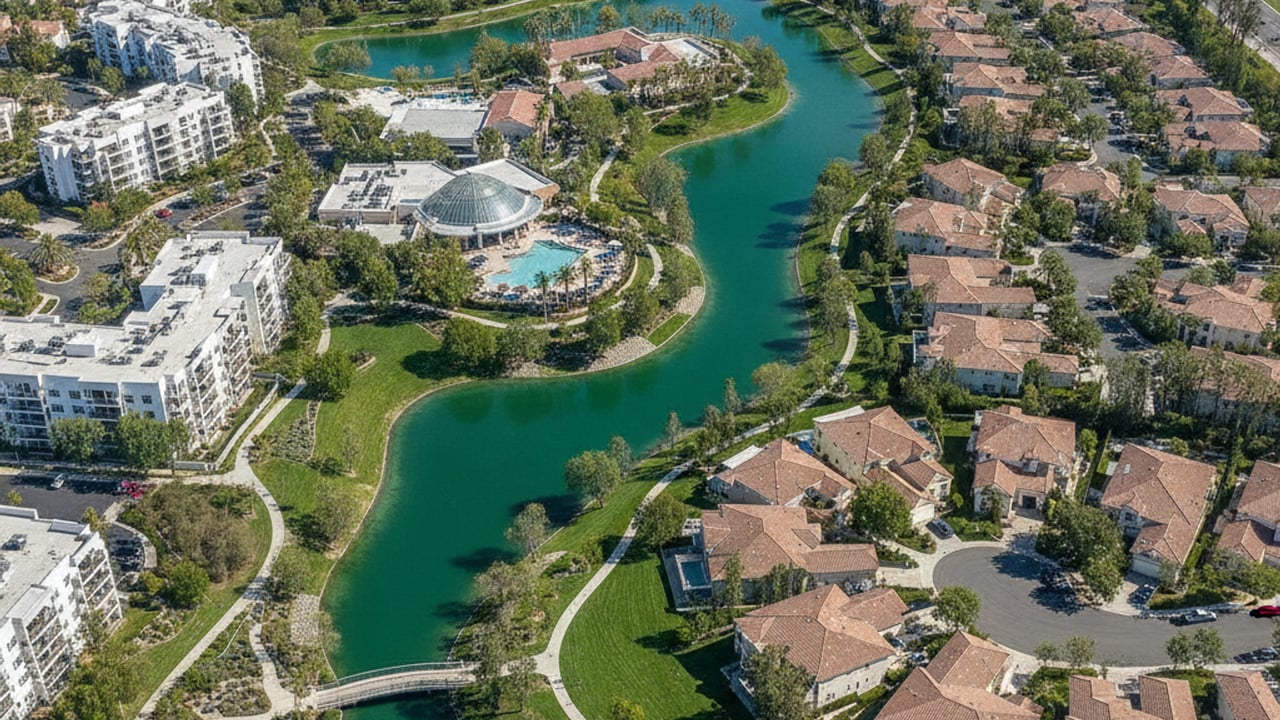
The village of Woodbridge in central Irvine has become a natural cluster for senior living options, partly because of the area's established network of paved trails and man-made lakes. Location matters here - it drives both property values and monthly fees across the city.
You'll find a range of options, from luxury campuses to more standard rental communities, scattered throughout the neighborhoods in Irvine. Two facilities are worth knowing by name.
Regents Point in Irvine
Regents Point is a Life Plan and CCRC operated by HumanGood, located at 19191 Harvard Ave., Irvine, CA 92612. The campus puts residents close to central Irvine amenities and shopping centers, making it easy to get around Irvine for daily errands.
As a CCRC, it requires an entrance fee and provides a continuum of care that runs from independent residential living through skilled nursing. Residents stay on the same campus even as medical needs increase - that continuity is the whole point of the model.
Woodbridge Terrace of Irvine
Woodbridge Terrace is a Kisco Senior Living community located at 1 Witherspoon, Irvine, CA 92604, situated within the Woodbridge development. It runs as a rental-based community, so there's no large upfront CCRC buy-in to contend with.
The facility offers independent living, assisted living, and memory care. Residents have access to the broader Woodbridge community amenities and local things to do in Irvine while receiving daily support from on-site staff.
What You Will Pay for Senior Housing in Irvine
General apartment rents in Irvine currently average between $2,976 and $3,266 per month, with one-bedroom units ranging from about $2,817 to $3,690. There's no dedicated average tracked solely for 55+ apartments, but these citywide figures set the baseline for what independent senior renters should expect when evaluating their cost of living in Irvine.
Add care services or specialized amenities, and costs climb above standard market rent. And if you're looking at a continuing care model rather than a standard monthly lease, the financial structure changes entirely.
Entrance Fees and CCRC Costs
National CCRC entrance fees typically range from $100,000 to over $1,000,000, averaging around $400,000. Orange County follows that national pattern - some local providers like Freedom Village offer refundable entrance fees starting around $112,000.
On top of the entrance fee, residents pay a monthly fee covering services and care. Orange County's average monthly CCRC fee currently sits at approximately $3,235.
Medicare and Low-Income Assistance
Medicare does not cover room and board in an assisted living facility or independent retirement community. It pays for specific approved medical services, short-term rehabilitation, or skilled nursing care - that's it.
For those who need more affordable options: a single person in Orange County earning $104,200 or less per year qualifies as low-income under 2026 state guidelines. Seniors meeting that threshold can apply for subsidized housing programs, though waitlists for these units are often long.
Benefits and Drawbacks of Age-Restricted Living
Homes in Irvine spend a median of 48 days on the market, so buyers generally have time to think before committing. That's worth using, because moving into an age-restricted community is a real lifestyle shift - and the rules are more specific than most people realize going in.
These neighborhoods are built for older adults, which creates a distinct environment compared to a standard residential subdivision. Knowing the trade-offs upfront saves you from surprises later.
Advantages of 55+ Communities
The main draw is maintenance. Most 55+ communities handle exterior landscaping, roof repairs, and common area upkeep through the HOA. That frees up time and physical energy in a way that's hard to replicate in a traditional single-family home.
There's also the social dimension - built-in peer networks and age-appropriate amenities. Many facilities feature single-story floor plans, wider doorways, and accessible bathrooms designed with aging in place in mind, all located in what is widely considered a safe place to live.
Common Downsides
The strict age requirements mean younger family members can't move in if their circumstances change. An adult child who needs a place to land won't be allowed to stay long-term - the HOA will enforce it.
HOA fees can also be substantial and are subject to regular increases. You'll pay for shared amenities like pools and clubhouses whether you use them or not. That's a real cost, and it compounds over time.
How to Select and Tour a Community
With roughly 4.6 months of housing supply currently available in the broader Irvine market, buyers have room to schedule multiple tours without feeling rushed. But no amount of research replaces actually showing up.
Visiting a senior living community in person is the only way to get a genuine read on the daily atmosphere and how staff actually behaves. Spend real time on the campus before you sign anything.
Questions to Ask During Your Visit
Ask for a printed schedule of monthly fees and a history of recent HOA or rent increases. You want to know how often rates go up and exactly what services are included in the base price - not the marketing version, the actual breakdown.
If you're touring an assisted living or CCRC facility, ask about the staff-to-resident ratio and caregiver turnover rate. High turnover has a direct impact on the consistency and quality of daily care, and it's something facilities don't volunteer upfront.
Reviewing Contracts and Rules
Before making a deposit, request a copy of the community's covenants, conditions, and restrictions. These documents spell out the exact rules on pets, parking, exterior modifications, and guest stays. Read them.
For CCRCs, have a financial advisor or attorney review the entrance fee contract. You need to know precisely what portion of the entrance fee is refundable to your estate and what triggers that refund. That detail matters more than most buyers realize until it's too late to ask.
Frequently Asked Questions
Which Irvine villages have active adult or 55+ neighborhoods?
Specific villages do cater to this demographic. The Woodbridge village is home to Woodbridge Terrace, a Kisco Senior Living community. Regents Point is located nearby at 19191 Harvard Ave.
What are the typical HOA fees and Mello-Roos taxes for retirement communities in Irvine, CA?
HOA fees vary widely depending on the level of care and amenities. In Orange County, the average monthly fee for a Continuing Care Retirement Community (CCRC) is around $3,235. Standard independent living condos will carry lower HOA dues, but may still have Mello-Roos taxes depending on the specific Irvine tract.
Can my younger spouse or adult children live with me in an Irvine 55+ community?
A younger spouse can usually live with you, provided at least one occupant meets the 55+ age requirement under the 80/20 rule. Adult children cannot live in the community full-time - HOAs enforce strict limits on how long underage guests can stay.
Are homes in Irvine senior communities sold as fee simple or are they on leased land?
It depends on the community. Some 55+ developments sell fee-simple condos or detached homes where you own the land. Others - particularly continuing care communities like Regents Point - operate on an entrance fee and monthly rent model rather than traditional real estate ownership.
What happens if I inherit a house in an Irvine retirement community but I don't meet the age requirement?
You can inherit and own the property, but you can't live in it if you're under 55. You'd need to either sell the home, leave it vacant, or rent it to an age-qualifying tenant - provided the HOA permits rentals.
Do Irvine retirement communities offer continuing care and assisted living, or just independent housing?
Irvine offers both. Communities like Woodbridge Terrace provide independent living, assisted living, and memory care. Regents Point operates as a full Continuing Care Retirement Community (CCRC) that includes skilled nursing.